

Winning back Saddam's trust?
U.S. foreign policy toward Iraq: 1983-1990 (Part 3)

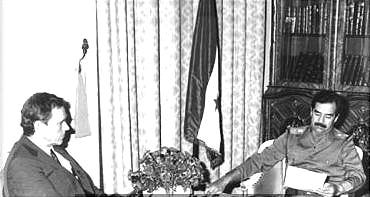
In November 1986, it emerged that the Reagan administration had been covertly and illegally sending weapons to Iran in return for the release of U.S. hostages.
The ‘Iran-Contra’ affair became one of the biggest political scandals in modern U.S. history, embarrassing the White House on several fronts. The Reagan administration had been caught deliberately defying Congress, abandoning its official stance of refusing to negotiate with terrorists, and undermining Western efforts to restrict arms sales to Iran. From a strategic viewpoint, the scandal also strained relations with Iraq and jeopardised Washington’s position in the Persian Gulf.
Until summer 1985, Washington had privately backed Saddam Hussein in the Iran-Iraq War, viewing him as a counterweight to the hostile regime in Tehran. However, when news broke that the U.S. also supplied defensive missiles to Iran throughout 1985-86, it exposed a dual-track policy in the Persian Gulf – alienating Iraq and deepening Saddam’s distrust of Washington.
In late 1986, after its strategic opening to Iran ended in public embarrassment, the Reagan administration renewed its tilt toward Iraq.
Conspiracy theories arise in Baghdad:
Following Reagan’s speech on 13th November 1986 – in which he admitted supplying Iran with defensive weapons – Saddam Hussein held a meeting with his advisers and declared:
‘This is nothing new. It is new in regards to their depravity, in the level of moral decay of the Americans and specifically their president. It is close to what we expected.’
Referring to the restoration of diplomatic relations with Washington in November 1984, Saddam continued:
‘Iraq has been friends with America for nearly two years right?... So what happened?...What changed about our position on Zimbabwe, or the Palestinian issue…What’s the one illegal thing that the Americans got from us?’
Saddam’s advisers downplayed the significance of the U.S. hostages in the Iran-Contra affair, instead concluding that the initiative was part of an American–Israeli plot to topple his regime. In another meeting on 15th November, Saddam told advisers:
‘The post-Khomeini era is coming soon…We have taken this era into account…and so do the Americans…Our fear is that Americans in particular, and with their allies, conspire at the expense of Iraq.’
Addressing the scandal, Saddam wrote to Reagan on 18th November, stating that U.S. actions had ‘shocked us and caused our great surprise...even aroused our suspicions.’ He argued that Washington had promised to restrict the flow of arms to Iran, but it had acted ‘counter to this declared policy which was agreed upon.’ By supplying missiles to Iran, the U.S. had helped to ‘bolster the Iranian war machine, prolong the war, and threaten the security and safety of Iraq and all the countries of the region.’ The letter concluded with Saddam urging Reagan to ‘reconsider this grave and harmful approach.’
Determined to secure a regional ally, Washington spent the next three years portraying the Iran-Contra affair as an aberration in U.S. foreign policy and not a conspiracy against Saddam.
Washington provides Iraq’s allies with naval protection:
From 1984, the ‘Tanker War’ had been a core aspect of the Iran-Iraq conflict, with both sides targeting each other’s oil infrastructure and merchant shipping in the Persian Gulf and Strait of Hormuz. Iran had also targeted Iraq’s allies, such as Kuwait, who had not only financed Saddam’s war, but provided logistical support.
In January 1987, the war escalated when Iran launched a massive assault on the port city of Basra – the bloodiest battle of the entire conflict. Security fears mounted in Kuwait; its shipping was under constant threat and the fighting now raged less than sixty kilometres from its border. The Gulf state therefore requested international assistance, appealing directly to both the U.S. and the Soviet Union. Whilst Cold War dynamics helped to shape Washington’s response, it was also driven by its renewed tilt toward Iraq and a desire to prevent Baghdad’s defeat.
By 7th March, Reagan authorised Kuwait to reflag eleven of its oil tankers as American vessels and placed them under U.S. naval protection. Publicly, the administration framed the move as necessary to protect international shipping in the Gulf, with Secretary of Defense Caspar Weinberger warning that without U.S. intervention:
“The Gulf would soon become a monument to Iranian intimidation and indiscriminate attacks on shipping.”
The danger to international shipping, however, was likely overstated – given that less than one percent of tankers transiting the Gulf had been struck since the war began. Instead, U.S. naval protection was a move to favour Iraq in the conflict, and on 13th March, National Security Advisor Frank Carlucci sent a memorandum to Weinberger stating the U.S. must:
‘Overcome the impressions created by our ill-fated initiative [in Iran]...we will need to monitor the war closely and be prepared to take additional steps if the Iranians appear to make more headway.’
Regardless of the motivation, U.S. naval presence in the region increased drastically throughout 1987, with more than thirty warships operating in the Gulf by the end of the year.
The USS Stark incident:
The expansion of U.S. naval operations in the Gulf carried significant risk, a reality highlighted on 17th May 1987, when an Iraqi fighter jet mistakenly identified the USS Stark as an Iranian tanker, firing two Exocet missiles and killing thirty-seven American servicemen. The following day, a statement was released by the White House declaring, ‘we expect an apology and compensation for the men who died in this tragic incident.’ Saddam quickly complied, and in a letter to Reagan on 18th May he stated, ‘I hope that this unintentional incident will not affect the relations between our two countries.’
Despite the loss of life, Washington appeared eager to defuse tensions, and on 19th May, Weinberger described the attack as a “single, horrible error on the part of the Iraqi pilot.” Reagan also deflected blame away from Baghdad, telling the press that ‘the villain in the piece really is Iran.’ Secretary of State George Shultz echoed this view, arguing that Iran’s threat to shipping had drawn the U.S. navy into the conflict zone, and Tehran therefore bore some responsibility for the deaths of American servicemen. Washington appeared as ready to forgive Baghdad as it was to criticise Tehran, and in a memorial service for the crew members of the USS Stark on 22nd May, Reagan declared, ‘our aim is to prevent, not provoke wider conflict.’
The renewed tilt toward Iraq was becoming increasingly clear, and when Assistant Secretary of State for Near Eastern Affairs Richard Murphy was pressed on how the U.S. would respond to a similar attack by Iran, he remarked it “would add a new dimension to the war.” Although the White House distanced itself from Murphy’s comments, his warning appeared accurate the following year.
Operation Praying Mantis:
Following a number of small skirmishes between Iranian and U.S. forces in the preceding months, the USS Samuel B. Roberts struck an Iranian mine on 14th April 1988. No crew members lost their lives, but unlike the conciliatory attitude taken toward Iraq in response to the USS Stark incident, Washington retaliated with force against Iran. On 18th April, the U.S. launched Operation Praying Mantis, sinking an Iranian frigate and shelling two oil platforms that were being used as command centres for attacks on shipping.
The operation severely damaged Iran’s naval capabilities, providing a boost to Iraq’s war effort and delivering a robust response to Tehran’s claim that the United States was a ‘paper tiger’. After eight years of conflict, and faced with the prospect of U.S. military escalation, the Iranian regime was placed under significant pressure.
Iraq’s continued use of chemical weapons:
Throughout 1987-88, as the U.S. expanded its naval operations in the Persian Gulf, Washington was made aware of Iraq’s continued use of chemical weapons against Iranian forces and Kurdish populations in northern Iraq. During the war, Kurdish groups such as the Patriotic Union of Kurdistan (PUK) had aligned with Iran in pursuit of greater autonomy. Saddam branded these groups as “traitors and agents for Israel and Iran”, using this rhetoric to justify widespread attacks on them.
In February 1988, Saddam launched the ‘Anfal campaign’ to eliminate Kurdish rebel groups, but in practice, the regime deliberately targeted entire communities in an act of genocide. The deadliest attack occurred on 16th March 1988, when Iraqi aircraft used nerve and blistering agents against the town of Halabja, killing an estimated five-thousand people. Western media visited Halabja soon after the attack, and graphic images of the aftermath forced the White House to condemn Iraq’s actions.
On 23rd March, State Department spokesman Charles Redman said the attack was “a particularly grave violation of the 1925 Geneva Protocol”, however, he attempted to apportion some responsibility on Tehran and claimed “there were indications that Iran may have also used chemical artillery shells in the fighting.” U.S. intelligence closely monitored Iraqi actions, and on 5th April 1988, a National Intelligence Daily authorised by CIA Director William Webster stated:
‘Recent fighting in northeastern Iraq has underscored the regular, recurring use of chemical weapons in the Iran-Iraq war.’
The report added that Iraq ‘probably would use chemical weapons in a battle for a major Iraqi city.’ Nevertheless, the Reagan administration’s policy toward Iraq remained largely unchanged, and Washington obstructed Iranian efforts to debate the issue at the United Nations Security Council. Ultimately, the UN passed only a limited condemnation against Iraq on 9th May.
In June, Assistant Secretary of State Richard Murphy privately told the Iraqi government:
‘The President has instructed me to reaffirm our commitment to a strong relationship with Iraq…and non-interference in Iraq’s internal affairs. We are not supporting and we will not support any individuals or groups who threaten Iraq’s unity and territorial integrity.’
The Prevention of Genocide Act:
Although Washington sought to preserve its relations with Baghdad, the situation in northern Iraq was becoming increasingly uncomfortable for senior U.S. officials. Just five days after the Iran-Iraq War ended on 20th August 1988, Saddam Hussein launched the final phase of his campaign against Iraqi Kurdistan. On 4th September, U.S. Ambassador April Glaspie therefore warned Iraqi Deputy Foreign Minister Nizar Hamdoon:
“The conduct of the Kurdish campaign may strain our ability to foster this cooperation to which we both aspire.”
After receiving clear evidence of chemical weapon use, Secretary of State Shultz also arranged a meeting with Iraqi Minister Sa’dun Hammadi, making clear that such attacks were unacceptable. In public, however, the State Department rejected claims of genocide. Frustrated by the administration’s handling of events, Senator Claiborne Pell therefore sponsored ‘The Prevention of Genocide Act’ which proposed economic sanctions on Iraq. The Senate passed the bill on 9th September, prompting immediate protests from Iraqi officials.
On 13th September, Glaspie sent a telegram to Shultz summarising a meeting between American engineering firm Bechtel and Iraq’s Minister of Industry, Husayn Kamil. Kamil launched into a ‘lengthy diatribe’ over the Prevention of Genocide Act, deploring the fact that America would ‘mix politics with business.’ Although the legislation was still being debated in Washington, Bechtel had already signed a contract to manage a two-billion dollar petrochemical project, and Glaspie stated that other ‘U.S. firms have reportedly won 300 million [dollar] contracts.’ Representatives of Bechtel warned that if the act was passed in the House of Representatives, the firm would ‘resort to non-U.S. sources to carry out their respective contracts’.
Resistance to the bill grew in Washington, as business lobbyists insisted that closer economic ties with Baghdad would moderate Saddam’s behaviour more effectively than sanctions. Peter Galbraith, a staff member on the Senate Foreign Relations Committee was inundated with letters from lobby groups concerned about the impact sanctions would have on their interests. By 1989, Iraq had become the single largest market for U.S. rice exporters, prompting Louisiana Senator John Breaux to tell Galbraith that passing the bill would be ‘committing genocide against his state’s rice farmers.’
Ultimately, opposition from business lobbyists and the Reagan administration defeated the sanctions legislation. The administration was unwilling to jeopardise relations with Baghdad, or risk losing out in the post-war reconstruction of Iraq– a stance Galbraith later condemned as ‘debasing appeasement of a dictator.’
Would Iraq become a ‘status-quo state’?
By the late 1980s, U.S. support had helped transform Iraq into one of the largest militaries in the world. Early signs however, suggested that Saddam would not use this strength to deliver the stability and security Washington desired in the Persian Gulf.
Instead, following the Iran-Iraq War, Saddam adopted a more confrontational attitude than U.S. officials anticipated – issuing threats toward several Gulf states, particularly Kuwait. In December 1988, a CIA report concluded, ‘Iraq is likely to remain more radical than its Arab allies and collide on occasion with regional rivals.’
In January 1989, a State Department report for incoming President George H. W. Bush still argued that economic incentives could turn Iraq into ‘a status-quo state, working within the system’. Washington soon discovered, however, that it had overestimated its influence in Baghdad, and underestimated Saddam’s deep distrust of the United States.
Bibliography:
*Photo source: Public domain, via Wikimedia Commons. Assistant Secretary of State for Near Eastern Affairs Richard Murphy meeting Saddam Hussein in 1986 to explain the unfolding Iran–Contra affair.
Primary Sources:
Meeting Transcript, ‘Saddam Discussing “Irangate‟ (Iran-Contra) Revelations with His Inner Circle’, Wilson Center Digital Archives, Saddam Files.
Meeting Transcript, 15th November 1986, ‘Saddam and His Advisers Discussing Reagan’s Speech to the Nation on “Irangate‟ (Iran-Contra) Revelations (Part 2)’, Wilson Center Digital Archives, Saddam Files.
8635961 - Letter from Saddam Hussein to Reagan, 18th November 1986, The National Security Archive.
‘Washing Talk: Department of Defense; Caspar Weinberger on Persian Gulf: Cap the Chameleon’, The New York Times, 9th October 1987.
Frank Carlucci memorandum to Weinberger, 13th March 1987, “Iraq 1987–1988” Box 4, 1/2 Burns Files.
‘Statement by Assistant to the President for Press Relations Fitzwater on the Attack Against the U.S.S. Stark’, 18th May 1987, Ronald Reagan Presidential Library.
Reagan, Q&A session - in Ronald Reagan, Public Papers of the Presidents of the United States: Ronald Reagan, 1987 (Best Books, 1989) p. 536
Reagan Speech, May 22nd 1987, Public Papers of Ronald Reagan.
National Intelligence Daily, 5th April 1988, National Security Archives.
05023 - Telegram, from April Glaspie to Secretary of State Shultz, September 13th 1988
CIA report, ‘Iraq's National Security Goals’, December 1988, National Security Archives.
State Department, ‘Guidelines for US–Iraq Policy,’ 20th January 1989, National Security Archives.
Secondary Sources:
Borer. D, ‘Inverse Engagement: Lessons from US-Iraq Relations, 1982-1990’, The US Army War College Quarterly, Vol. 33, No. 2
Fredman. Z, ‘Shoring up Iraq, 1983-1990: Washington and the Chemical Weapons Controversy’, Diplomacy and Statecraft, Volume 23, Issue 3.
Galbraith. Peter W, The End of Iraq: How American Incompetence Created a War Without End. (Simon & Schuster, 2006.)
Hiltermann. J, A Poisonous Affair: America, Iraq, and the Gassing of Halabja, (Cambridge University Press, 2007).
Hunter. R. E, “The Reagan Administration and the Middle East” Journal of Third World Studies, vol. 4, no. 2, 1987, pp. 95–105.
Kelly. M.J, ‘The Anfal Trial against Saddam Hussein’, Journal of Genocide Research, Vol. 9, Issue 2, 2007, p. 235
Lamar. J.V, ‘Why Did This Happen?’, Time Magazine, 1st June 1987.
Ramazani. R.K, ‘The Iran-Iraq War and the Persian Gulf Crisis’, Current History, vol. 87, no. 526, 1988.
Trainor. B, ‘Washing Talk: Department of Defense; Caspar Weinberger on Persian Gulf: Cap the Chameleon’, The New York Times, 9th October 1987.
Travis. H, “The United Nations and Genocide Prevention: The Problem of Racial and Religious Bias.” Genocide Studies International, vol. 8, no. 2, 2014, pp. 122–52.
Finally! Part 3 :)